

1. Match Output to Your Most Demanding Vehicle, Not Your Average One
The most consistent sizing mistake in fleet charging deployments is speccing a charger around the average vehicle in the fleet rather than the heaviest.
For a depot running electric vans or company cars, a 150kW rapid charger is serviceable. But for fleets that include electric HGVs, double-decker buses, coaches, or high-payload LCVs, the calculus changes entirely. These vehicles can accept significantly higher charge rates — and when one is queued behind a smaller vehicle that’s occupying a full power allocation it can’t use, your site efficiency drops accordingly.
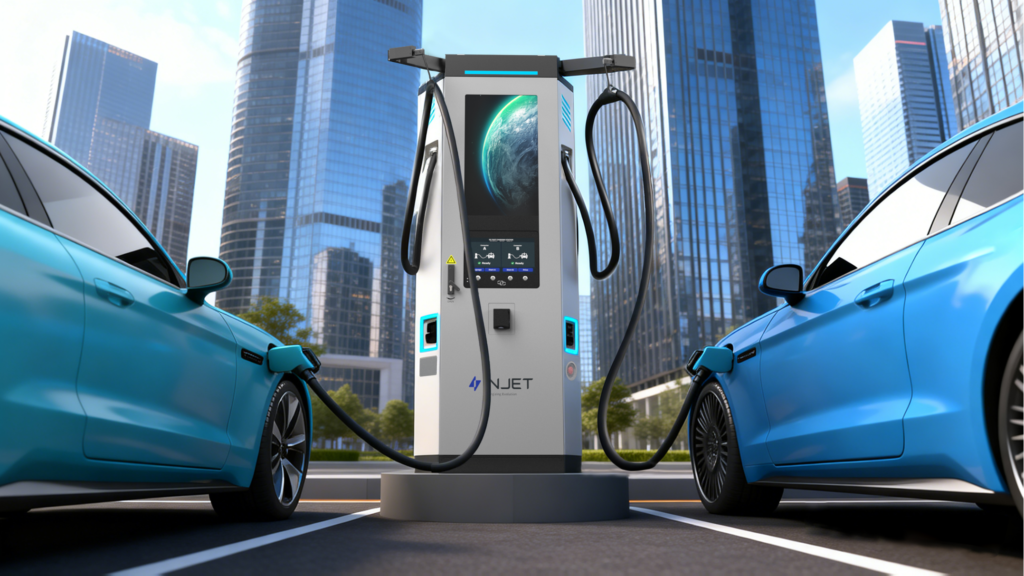
The practical threshold for heavy-duty UK fleet applications starts at 320kW. The Injet HanHui 480 delivers up to 480kW in its liquid-cooled configuration, with output currents reaching 600A — sufficient for the most demanding commercial vehicles currently operating on UK roads. That’s a 50% increase in peak output over a 320kW unit from the same footprint and single-unit installation cost, which translates directly into shorter dwell times during peak depot hours.
What to check: Confirm peak output, maximum output current in amps, and whether that peak is available on both connectors simultaneously or only one at a time.
2. Static Power Allocation Is a Hidden Throughput Killer
Most dc fast chargers divide their rated output evenly between connectors — irrespective of what each connected vehicle actually draws. In a mixed fleet depot, this creates a consistent waste problem: an electric van draws a 240kW allocation it can only use at 80kW, whilst the electric coach on the adjacent connector waits for power that’s sitting idle.


We'll Reach Out.